
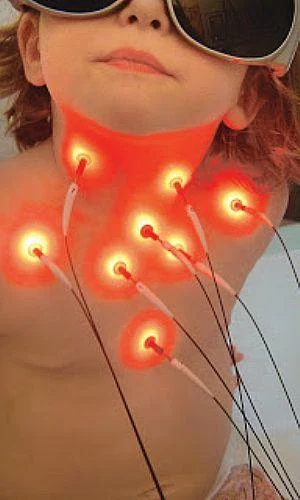
Acupuncture with EY-LLLT applies the principles of acupuncture using the special LLLT device
Avoiding a needle may change the experience, but does not establish universally painless application or automatic suitability for every child. Light treatment requires individual assessment, appropriate parameters and protective measures for the device and application area.
In EY-LLLT, optical fibres deliver light to selected points. The technique is not clinically equivalent to needle insertion merely because of the chosen locations. Point numbers and technical features describe a protocol without establishing effectiveness for every condition discussed in relation to medical acupuncture.
Possible cellular responses are investigated as photobiomodulation mechanisms. They do not justify a universal promise of faster healing or shorter recovery. Standalone or combined use needs evidence for the particular goal and coordination with the treating clinician. Each publication must be interpreted in relation to its population, comparison and measured outcome. Studies of different diagnoses, techniques or experimental models should not be treated as interchangeable proof for an individual application.
References
- Attia AM, Ibrahim FA, Abd El-Latif NA, Aziz SW, Elwan AM, Abdel Aziz AA, Elgendy A, Elgengehy FT. Therapeutic antioxidant and anti-inflammatory effects of laser acupuncture on patients with rheumatoid arthritis. Lasers Surg Med. 2016 Jul;48(5):490-7.
- de Oliveira RF, de Freitas PM. Laser therapy on points of acupuncture on nerve repair. Neural Regen Res. 2016 Apr.
- Dabbous OA, Mostafa YM, El Noamany HA, El Shennawy SA, El Bagoury MA. Laser acupuncture as an adjunctive therapy for spastic cerebral palsy in children. Lasers Med Sci. 2016 Aug.
- Tseng CC, Tseng A, Tseng J, Chang CH. Effect of Laser Acupuncture on Anthropometric Measurements and Appetite Sensations in Obese Subjects. Evid Based Complement Alternat Med. 2016.
Therapeutic light and LLLT acupuncture
Using light rather than a needle does not by itself establish an outcome or absence of risk. The particular technique requires its own assessment.
Continue with Laser Acupuncture, or browse LLLT acupuncture and low-level laser for related articles.
What laser acupuncture describes
Laser acupuncture uses light at selected points instead of conventional needle insertion. This describes a method of application rather than proving that the two interventions have identical effectiveness. Evidence needs to concern the actual technique and proposed goal. A favourable result from needle acupuncture cannot automatically be transferred to every light device, even when similar point names or selection principles are used. The question remains what this particular application can reasonably achieve for a particular clinical problem.
A name such as EY-LLLT or another commercial description does not identify all technical parameters. Wavelength, power, duration and application area determine what is delivered. Publications report these details so procedures can be compared or reproduced. A patient needs an understandable explanation rather than specialist calculations, but the general word technology cannot replace a clear protocol and appropriate training. Ask whether the cited research concerns the same type of device, exposure and population as the service being discussed.
Dose is not expressed only in minutes
In photobiomodulation, energy reaching an area depends on more than appointment duration. Intensity, exposure area and method of application matter. Research reviews describe responses that do not necessarily increase as dose increases. More light or more appointments therefore do not automatically mean a better result. Numbers from a study are not safe instructions for improvised use of a different home device. Appropriate settings cannot be selected simply by assuming that a longer or stronger application must be more effective.
References may include experiments in cells, animals or people with different conditions. These categories do not carry the same clinical meaning. A change in cellular activity can help generate a hypothesis without proving faster recovery in every patient. Mechanistic research needs to remain distinct from clinical trials. A broad list of proposed uses should not be treated as established indications unless each application has relevant supporting evidence. The age or sophistication of a device is also separate from the quality of those data.
Before choosing a session
Initial discussion includes diagnosis, symptoms, existing treatment and a functional goal. Avoiding skin penetration may change the experience, but safety information is still necessary. Ask about eye protection, application sites and circumstances in which the procedure should stop for assessment. Suitability for children or particular medical situations is individual; it does not follow from a low-power label. An absence of immediate sensation is not enough to determine whether the exposure is appropriate or whether the intended outcome has been achieved.
If combination with needles or another intervention is proposed, clarify its rationale and evidence. Adding techniques does not guarantee additional benefit and can make it harder to identify what helped. Usual care and communication with the treating clinician remain important. New or worsening symptoms need clinical assessment rather than being automatically described as a normal response that must be endured for treatment to work. Clear instructions should explain how concerns are reported between sessions as well as during application.
Agree review and financial commitment
Pricing should explain the service, initial assessment and planned reassessment. A general article cannot determine a universal number of sessions. Agree a concrete outcome, such as a daily activity, and a review point. Price concerns the service and is not evidence of effectiveness. Decisions can change if worthwhile benefit is absent, difficulties arise or new clinical information becomes available. A review plan keeps the discussion connected to the person’s experience rather than to a technical explanation alone.
Sources for further information
Photobiomodulation and light parameters
Does having no needle make an application suitable for everyone?
No. Purpose, parameters and medical history still matter. Describing a technology does not replace information before an application.
Are all LLLT applications the same procedure?
No. The application site, wavelength, power and dose can differ. A description of a mechanism or a particular study cannot be transferred unchanged to every device and application.