
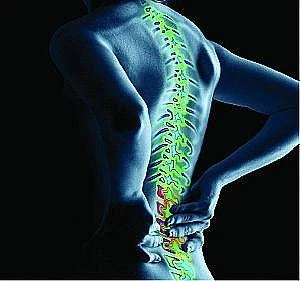
80% of people experience acute lumbar pain at some point in their lives, and of these, 1–2% become chronic sufferers.
The effectiveness of acupuncture in treating lower back pain has been validated by many studies published in reputable medical journals such as Pain. Numerous studies provide evidence that acupuncture is a safe and effective procedure with potential risks that need assessment.
The patient is asked to visit their attending physician for a detailed medical history, clinical examination and laboratory investigation to identify the exact cause of the lumbar sciatica before acupuncture is applied.
The main causes are:
1. Herniated intervertebral disc (disc disease), accounting for 70%
2. Degenerative spondyloarthritis
3. Traumatic causes
4. Psychosomatic disorders
5. Organic causes such as inflammatory bacterial infections, neoplasms, congenital abnormalities, diseases of neighbouring organs, osteoporosis, etc.
Clinical presentationThe typical presentation is characteristic: lower back pain, usually severe, which generally begins after a sudden movement or lifting a weight. The pain may be localised or radiate into the legs. Pain also often begins “without a cause” and without a history of injury. At other times, it starts in the calf, thigh or hips and extends to the lower back. Medical examination usually reveals loss of the spine’s normal lordosis and antalgic scoliosis (leaning the body to one side because of pain felt on the other).
Movement is restricted, and the sufferer has difficulty bending forwards and sideways. Rotational movements of the lower back do not usually cause any particular pain problem. Increased tenderness in the lower back (towards the hips), pain when the buttocks are pressed and, very often, pain and tenderness in one leg are observed.
In all cases, there is reduced strength and an inability to perform certain movements without pain. The pain worsens with coughing or sneezing.
Treatment options
Treatment of any lower back problem requires a medical assessment by the attending physician to identify the causes before acupuncture. Once the causes have been established, treatment must be fully individualised according to the causes of the problem, age, predisposition, the number of previous similar problems, occupation and daily activities. Treatment is divided into conservative and surgical treatment (in more severe cases or where conservative treatment has failed).
Conservative Treatment:
- Medication
- Bed rest
- Lumbar support belt
- Physiotherapy–Kinesiotherapy
- Acupuncture
Acupuncture can contribute effectively to patients’ faster recovery, provided that the primary disorder is not characterised by severe anatomical changes.
Acupuncture points are selected according to the pathogenesis of the disease and the patient’s symptoms. Local and distant points are used.
The needles are usually placed in the painful area and may be connected to an electrotherapy device.
Acupuncture increases the analgesic effect through the secretion of endogenous opioid analgesic peptides, while also mobilising the contracted paraspinal muscles. This mobilisation releases the muscle spasm, increases local blood flow, removes lactic acid accumulated through prolonged muscle contraction and suppresses the inflammation involved in producing pain.
Additional advice:
- Weight reduction–Diet
- Avoid lifting weights
- Thermal baths–Exercise in the swimming pool
- Avoid unnecessary strain and needless fatigue
References
- Sit RW, Wong W, Law SW, Wu JC. Integrative Western and Traditional Chinese Medicine service model for low back pain. Int J Clin Pharmacol Ther. 2016 Jul;54(7):539-43. doi: 10.5414/CP202625.
- O’Gara T, Kemper KJ, Birkedal J, Curl W, Miller N, Abadie B. Survey of Conventional and Complementary and Alternative Therapy in Patients With Low Back Pain. J Surg Orthop Adv. 2016 Spring;25(1):27-33.
- Lin R, Zhu N, Liu J, Li X, Wang Y, Zhang J, Xi C. Acupuncture-movement therapy for acute lumbar sprain: a randomized controlled clinical trial. J Tradit Chin Med. 2016 Feb;36(1):19-25
- Ushinohama A, Cunha BP, Costa LO, Barela AM, Freitas PB.Effect of a single session of ear acupuncture on pain intensity and postural control in individuals with chronic low back pain: a randomized controlled trial.
Braz J Phys Ther. 2016 Jun 16 ;0:0. doi: 10.1590/bjpt-rbf.2014.0158.
Back pain radiating into the leg
Sciatica describes a symptom pattern that needs clinical context. It does not by itself establish one common cause.
Explore Musculoskeletal conditions and pain or read how Medical Acupuncture Methods is presented at Satory.
Understanding pain and treatment goals
What does the distribution of leg discomfort add?
It helps describe symptoms alongside duration, movement and accompanying difficulties. Interpretation belongs within clinical assessment.
What information helps a clinician assess pain?
Location, duration, intensity and effects on movement or sleep provide different information. Previous injuries, investigations and treatments already tried also help frame the discussion.