
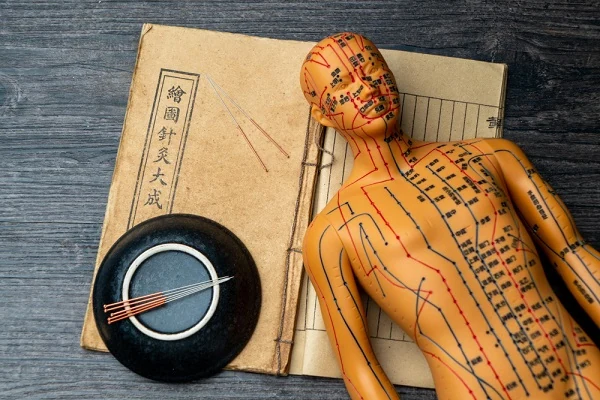
The history of acupuncture begins 4,000 years ago in China.
The theory and practice of acupuncture began in China and were first recorded in documents dating to a few hundred years before the Common Era.
Early tools and later accounts require historical interpretation. The use of pointed stones or bones does not by itself establish that the present technique was practised in the same form in 6000 BC.
The decline of acupuncture
From the 17th century onwards, interest in this tradition declined because it was considered irrational. The emperor’s decree in 1822 excluded acupuncture from the Imperial Medical Institute. Rural healers and some scholars preserved knowledge of the practice.
With the rise of Western medicine in the 20th century, acupuncture practices fell further into disrepute. In 1929, it was outlawed in China along with other forms of traditional medicine.
Revival of Traditional Chinese Medicine
The Communist Government in 1949 revived traditional forms of medicine, including acupuncture. Research institutes were established throughout China in the 1950s, and the practice became available in many hospitals.
The practice spread to many other countries. The European physician Ten Rhijne, who worked for the East India Company, described the practice medically around 1680. During the first half of the 19th century, both America and Britain developed an interest in this ancient form of treatment.
It was in 1971 that a member of the American press underwent acupuncture treatment while recovering from an emergency appendectomy in China, which he was visiting. He described the experience in The New York Times and generated interest in the procedure’s success.
The NIH consensus conference in 1997 examined evidence for particular applications of acupuncture. It represents a historical scientific discussion, rather than general approval of every indication or a substitute for present guidance.
Acupuncture is historically associated with organised traditional theories. The existence of a theoretical system does not by itself demonstrate an ability to diagnose, prevent or treat every disease.
Different questions for historical and clinical assessment
- Traditional theories are studied within their cultural and historical setting.
- Diagnosis requires appropriate clinical assessment and investigations when indicated.
- Prevention claims need evaluation for the particular condition and population.
- The effectiveness of a treatment application is assessed using comparative clinical evidence.
- Participation in modern research means that hypotheses are tested, results compared and conclusions open to revision when better evidence becomes available, rather than demonstrating that every traditional claim is already established.
Medical acupuncture may be discussed as a complementary option for particular goals. Appropriate training, information about the evidence and risk assessment are necessary. The intervention is not free from adverse effects and cannot guarantee health, well-being or balance for every person who receives it.
Acupuncture history: key milestones
History explains how acupuncture’s place has changed. The age of a practice does not by itself answer questions about effectiveness.
For a description of the method, see Medical Acupuncture Methods. Related reading: More articles on health and acupuncture.
Reading a history as a history
Acupuncture’s history records changing explanations of the body, approaches to training and ways of delivering treatment. A useful reading separates what an original source describes from what a later author concludes. Evidence that a practice existed establishes its use in a particular setting. It does not automatically establish its effectiveness according to the standards used for clinical decisions today.
Names can also conceal differences. Acupuncture may refer to different points, depths, manipulations and theoretical explanations. When reading a historical account, it helps to ask which procedure was actually described, who received it and what its practitioners hoped to achieve. Without those details, a familiar label may suggest continuity between practices that were substantially different in important respects.
What clinical investigation adds
Feeling better after a treatment is an observation worth recording, but it cannot explain the change by itself. A clinical investigation considers the course of the condition, other care, expectations and the comparison group. These details help researchers examine whether an intervention contributes an additional effect and whether the difference matters to the person receiving it.
The NIH consensus conference in 1997 is a historical milestone in this discussion. Its conclusions belong to the questions and evidence available at that time. A present decision also requires relevant later research and guidance for the particular condition. An old conference cannot serve as a permanent general endorsement of every application that subsequently adopts the same name.
Distinguishing theories, devices and outcomes
Traditional maps and descriptions of Qi form part of the method’s historical setting. Contemporary investigations ask different questions, including questions about neural responses and pain processing. A proposed mechanism is not a measurement of how much an individual will benefit. Nor does identifying a response establish which diseases should be treated with the intervention in ordinary clinical practice.
Devices require another distinction. Rules about the quality and safe use of a needle concern the medical device and its delivery. They do not demonstrate that every protocol using that needle is effective. The Medical Acupuncture Methods overview can help identify which technique is being discussed before comparing an older account with a contemporary treatment description or research report.
A practical way to check historical claims
For each important claim, note the date, the original source and the kind of evidence offered. A personal account, a description of a school and a controlled trial answer different questions. This simple classification makes it easier to notice when a narrative moves from describing a historical event to making a medical conclusion without supplying the evidence needed for that transition.
For someone considering care now, history can prompt useful questions: what is the proposed aim, what evidence supports that aim, and how will progress be assessed? Answers depend on the diagnosis and the person’s circumstances. The age of a practice is culturally interesting; suitability, safety and the expected balance of benefits and burdens require a separate discussion grounded in the current clinical situation. Historical accounts also rarely provide consistent follow-up. An immediate report of relief and an improvement maintained months later answer different questions. Checking when an outcome was assessed helps prevent an appealing story from being treated as evidence of a lasting effect.
Sources for further information
Medical acupuncture and evidence
Why read a historical source differently from a clinical study?
A historical source describes a period, practice or belief. A clinical study investigates a defined question using a method, participants and outcome measures.
Does recognition of a method establish an indication for every condition?
No. Training, regulation of instruments and evidence of effectiveness are different matters. Each application is considered for its particular purpose, medical history and relevant evidence.